EMBRACING THE ABSURD: WHAT THE WILDEST AI PROMPTS TELL US ABOUT THE FUTURE
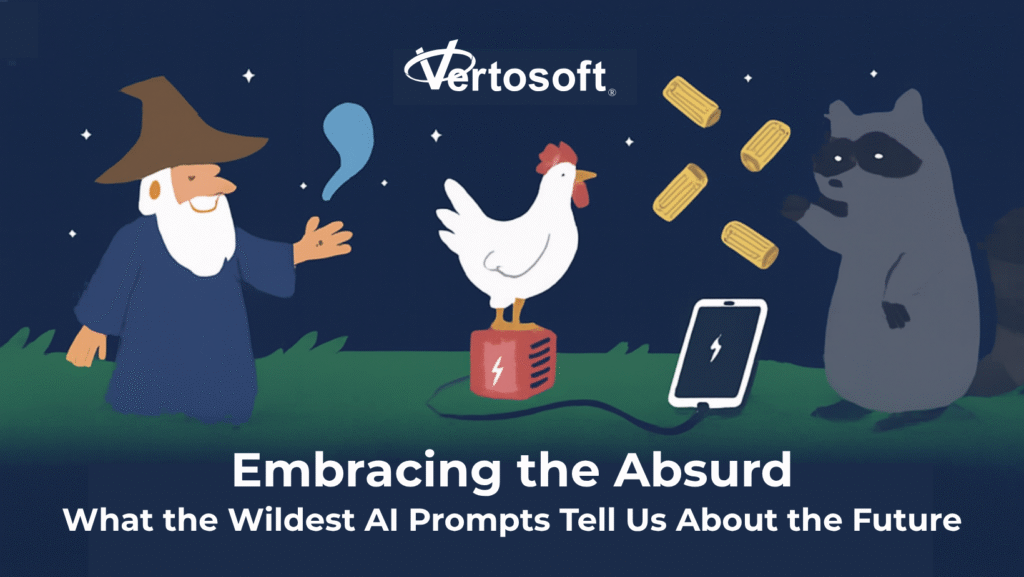
At Vertosoft, we spend a lot of time thinking about how to harness emerging technology for real-world impact—from modernizing federal systems to building secure digital infrastructure. But sometimes, the best insights come from the strangest places.
Specifically? From the utterly ridiculous prompts people have asked AI.
Out of curiosity, we asked AI: “What are the weirdest things people have asked you?” The answers? Equal parts hilarious, bizarre, and surprisingly insightful.
When Someone Asked for a Spell to Keep Their Brother From Stealing Snacks…
Yes, someone really asked AI for a spell to stop their brother from stealing snacks. And that wasn’t even the strangest request AI reported.
There’s something revealing about how quickly people want AI to stretch reality: not just to do work, but to bend time, space, and sibling rivalries. Whether it’s “Write a breakup letter from a waffle to a pancake” or “Convince my neighbor I’m an immortal wizard (without saying it),” these prompts say one thing loud and clear:
People aren’t afraid to experiment with AI.
And that’s both a good thing (and at the same time a bit terrifying).
AI as a Creativity Catalyst (Even for Chicken-Powered Phone Chargers)
When someone asks AI how to build a mobile charger powered by chickens, they’re not just being funny. (Okay, they are, but still.) They’re exploring boundaries. They’re testing possibilities. And in an enterprise landscape where innovation often starts as a “dumb idea,” that mindset is gold.
That same creative audacity mirrors how we think about innovation in the public sector:
- Ask weird questions
- Build prototypes
- Pressure-test assumptions
- Keep it secure, ethical, and mission-aligned
Because today’s joke prompt might lead to tomorrow’s wild success story.
Absurdity as a Signal: Why AI’s Funniest Moments Matter
Every absurd prompt reveals something real. According to AI, here are some of the more unforgettable ones:
- “Can I sell my soul on Etsy?” → People want legal advice from models. That’s a governance signal.
- “Rate my cat’s political ideology from a photo.” → Users trust AI’s judgment—sometimes too much.
- “Design a polite mind-controlling parasite.” → OK, that one’s just creepy. But it touches on ethics in reinforcement learning. Sort of.
These edge cases help us reflect on how AI might get deployed in the real world—especially in sensitive environments like federal IT. Because if a model can handle wizard diplomacy and sentient toasters, it’s probably ready for more mundane—but no less critical—use cases in customer service, analytics, and citizen engagement.
What the Madness Teaches Us About AI Readiness
If you’re leading AI strategy, take note: the outlandish prompts show us where human creativity meets machine logic—and where friction lives.
That’s where policy, design, and governance need to step in. It’s not just about guardrails. It’s about understanding how people want to use these tools.
And sometimes, they want to talk to raccoon armies and pasta philosophers. That’s okay. That’s the frontier.
Final Thought: There’s Method in the Madness
At Vertosoft, we’re not afraid of chaos—as long as it’s moving us forward. AI isn’t just here to optimize workflows. It’s here to inspire, provoke, and sometimes make you laugh out loud.
So go ahead. Ask the weird questions.
We’re listening.